

It’s clear that were heading into a future where there is no more software in the classical way, but AI doing jobs that currently classic software does. This future might be some years or decades away, but we can see parts of it happening right now. For example I already use an AI for accounting. Claude Code classifies all my incoming invoices and loads them into some financial software - there is no code, no IFs and THENs that classifies the invoices, it’s just AI.
Contrary to that, most organizations write classical code to solve problems today.
This bears the question: How do we migrate classical software engineering organizations to an AI only mode?
My CTO coaching clients seem to be overwhelmed by the road ahead, so are many CTOs and CEO founders I’ve talked to over the last months.
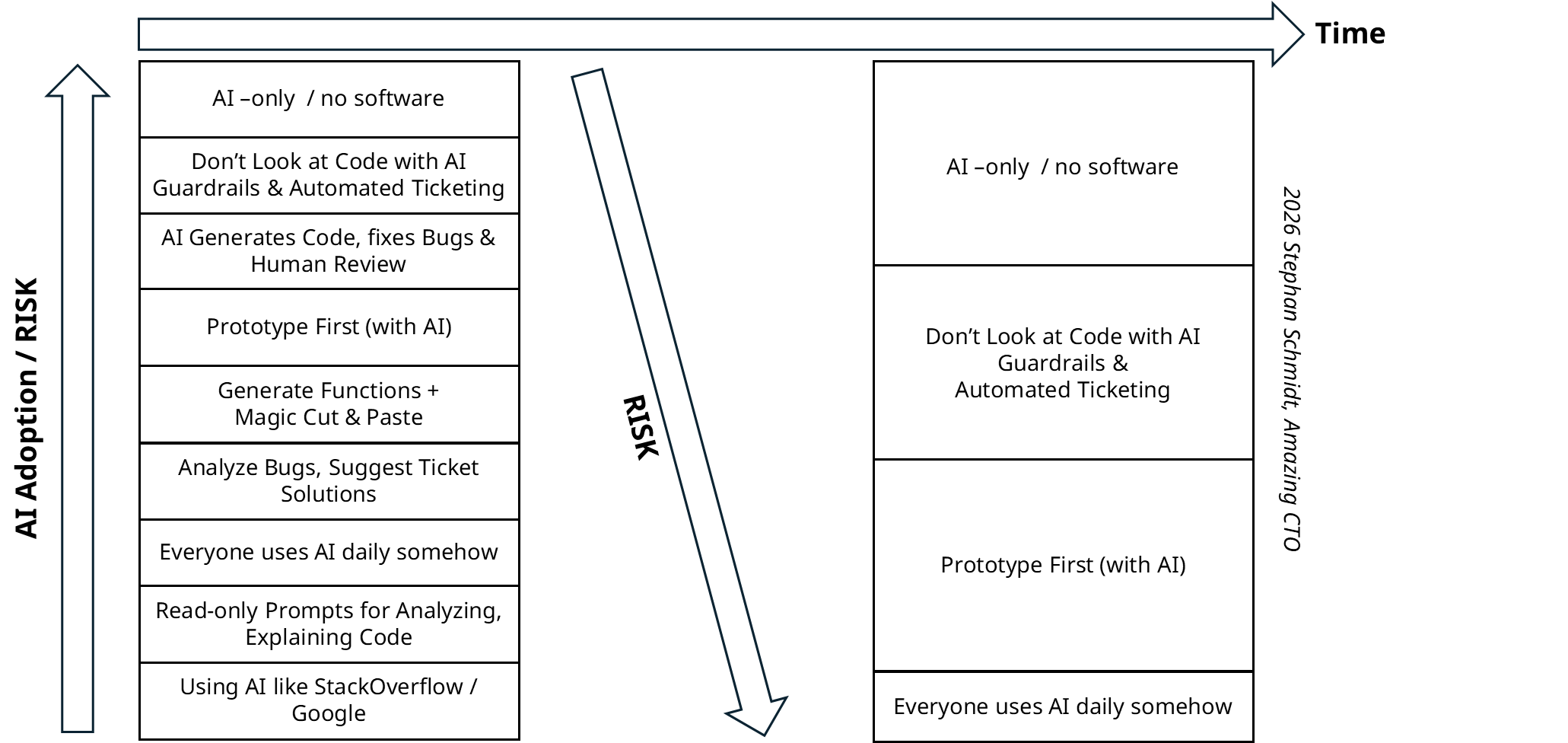
To help them to overcome challenges and plot a path into the future I came up with my AI adoption levels. You go from level one, replacing Google search with asking an AI, on the lowest level to AI-only on the highest:
Using AI like Stack Overflow / Google
Read-only Prompts for Analyzing, Explaining Code
Everyone uses AI daily somehow
Analyze Bugs, Suggest Ticket Solutions
Generate Functions + Magic Cut & Paste
Prototype First (with AI)
AI Generates Code, fixes Bugs & Human Review
Don’t Look at Code with AI Guardrails & Automated Ticketing
AI –only / no software
Using AI like Stack Overflow / Google
Instead of Googling a solution or searching Stack Overflow, developers ask an AI for guidance and knowledge on how to implement a feature, use some API, solve some problems, find some third party library to include. The AI does not read or write the code, the developer translates from the code into AI and AI responses into code.
Read-only Prompts for Analyzing, Explaining Code
The developer uses an AI to analyze code for bugs, security problems, pen testing. The AI is also used to read configurations from production, read Github CI/CD setups, Terraform configs for the developer to understand what is going on. When moving to a module or a microservice they don’t know, or for revisiting code they haven’t worked with for a long time, developers ask the AI to explain the code, draw an ASCII architecture diagram etc. This is especially useful during onboarding for new developers. Prompt examples and prompt training are essential here. Developers learn proper prompting for the AI to understand code at this point. AI is used to check if dependencies are necessary, should be upgraded, replaced or removed.
Everyone uses AI daily in one way or another
This is a major milestone. AI is no longer a tool you reach to from time to time but an indispensable tool everyone uses everyday. As a manager this is the first milestone to achieve and you should measure AI usage to understand if you’re there yet.
Analyze Bugs, Suggest Ticket Solutions
AI is used to find the reason for bugs, suggest bug fixes. AIs are particular good at that because they relentlessly read code and documentation and get a much broader grasp about the model in the code than developers could ever do. On this level, the AI reads a ticket from Github, Linear or Jira and suggests a plan for implementation - after reading the ticket, reading the code base and reading all internal and external documentation available. It’s particularity important here that documentation exists and is written in an AI accessible form - not primarily for the consumption of developers but the consumption through AIs. Everything that is distributed as knowledge in heads of developers needs to be externalized and made accessible to AIs here.
Generate Functions + Magic Cut & Paste
On this level, AI generates code - this is another major milestone. Developers trust AI enough to let it write code. Developers use the AI for generating functions, mostly side effect free functions that are tedious for developers to write - like manipulating deep object trees - but simple to write. AI is used to generate data objects, transfer objects, database mappings or simple controllers. Developers use copy and paste for new code, then select the code and let the AI magically fix and adapt the code.
Prototype First (with AI)
Here the organization has moved to prototype first. No longer are tickets written, UI designs created before code is written. Instead a ptrototype is created to evaluate the idea, check how it should look like, gather input from stakeholders. After the prototype is created, tickets, UI documents and requirements are created by an AI.
AI Generates Code, fixes Bugs & Human Review
AI does all the coding at this level. Developers interact with the model with specs, tickets and prompts, they no longer write code themselves. After the AI has written the code, developers review all code written. This is the last level of human owned code.
Don’t Look at Code with AI Guardrails & Automated Ticketing
We now have transitioned into AI owned code. The AI reads and writes code. Guardrails are implemented for the AI - around security, operations, data protection, privacy, performance and long term maintainability of code. People interact with the AI through tickets. The AI reads a ticket changes the code, commits and deploys on it’s own.
AI –only / no software
The last level of an AI transition is the replacement of software as the primary tool to solve problems. Instead of writing an ERP system, the AI does ERP with tool integrations and data storage. Instead of a CRM system that sends out emails, the AI does this. Instead of writing a game, the AI creates a game on the spot that you can play - how the AI does this internally is no longer relevant. Today we already see this in military drones.
With these levels it should be easier for you to transition towards more AI and give clear guidance to the people around you on the journey.
Some notes:
These levels overlap. Each developer in an organization is on their own level, some are ahead, some behind.
Different parts of the code base have different levels. The easier and non critical parts are ahead, the more complex and critical parts are behind.
With increasing the levels, risk of failure increases but potential gains increase too.
Different industries have different state-of-the-art levels, depending on risk appetite. Fintech, Health-ech, Firmware, Avionics and other critical systems will lag behind - startups with simple and low risk problems will leap ahead.
Over time, the risk of each level decreases. Within the next decade AI only will be the default solution to problems.